
Seven thousand euro a month. That is the whole withdrawal allowance a new Golisimo account gets, and it is the single number that holds this cashier to 6.6/10. Deposits are easy, cheap and quick to set up. Taking money back out runs through a tiered ceiling, a business-hours finance desk and a rollover rule, all written into the operator’s own terms.
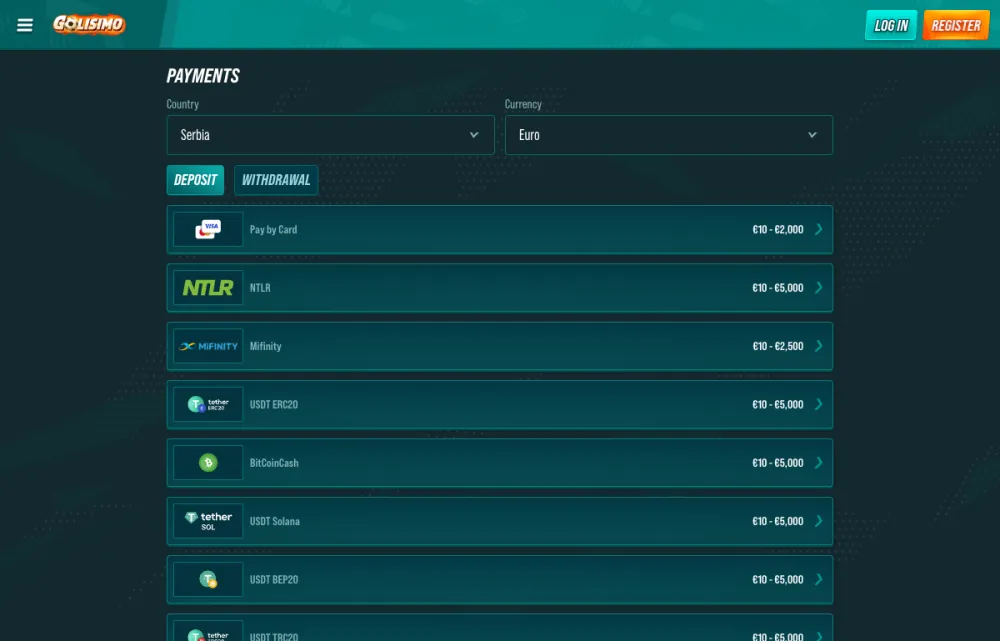
Everything here comes from two primary documents: the operator’s own rulebook in revision 1.12, issued 19 August 2026, which we read clause by clause, and the live payments page we captured on 27 October 2026. Where the operator publishes a figure, we quote it with its clause number. Where it publishes nothing, you will see the words “not published”, because guessing a payout time would be worse than admitting the gap.
Cashier facts at a glance
Nineteen rails, two account currencies and one ceiling that matters more than all of them.
- Minimum deposit: €10 on everything except Bitcoin
- Bitcoin minimum: €30
- Account currencies: EUR and USD, nothing else
- Largest single deposit: €5,000 (crypto and NTLR)
- Card cap per transaction: €2,000
- Withdrawal processing: 3 business days after the request
- Entry-level ceiling: €500 a day, €7,000 a month
- Pending withdrawals allowed at once: three
- Withdrawal fees: not published
Read that list twice and the shape of the problem shows up on its own. Getting money in is frictionless by design. Getting it out is governed, metered and capped.
Deposit rails and their limits
Deposit rails number nineteen, and sixteen of them are crypto. The payments page shows three fiat options and a long column of coins, each with its own per-transaction window (2). The table below is that screen rewritten as a matrix, with deposit speed and withdrawal speed separated, because only one of those two is something the operator commits to.
| Method | Minimum | Per-transaction cap | Speed in | Speed out | Notes |
|---|---|---|---|---|---|
| Pay by Card | €10 | €2,000 | Immediate on authorisation | Not published | May be repaid as a purchase refund (6.6.5) |
| MiFinity | €10 | €2,500 | Immediate | No rail figure | E-wallet; qualifies for promotions |
| NTLR | €10 | €5,000 | Immediate | Absent from the terms | Processor rail, highest fiat cap |
| Bitcoin | €30 | €5,000 | One network confirmation | Not published | Only rail with a raised floor |
| Bitcoin Cash, Litecoin, Dogecoin | €10 | €5,000 | Once the block confirms | No figure given | Converted to EUR or USD on arrival |
| Ethereum, BNB, TRX | €10 | €5,000 | Confirmation on the chain | Unpublished | Network fee is yours, not the casino’s |
| Solana, Cardano | €10 | €5,000 | Seconds, once confirmed | No timing stated | Cheapest fees of the listed chains |
| USDC, USDC Solana | €10 | €5,000 | Confirmation-dependent | Not disclosed | Stablecoin; removes price risk on the way in |
| USDT (ERC20, TRC20, BEP20, Solana) | €10 | €5,000 | Varies by network | No window published | Four chains; pick the one your exchange supports |
The “speed out” column is empty for a reason, and it is the most honest column on this page. Golisimo commits to a processing window in its terms, which we come to shortly, but it attaches no timing to any individual rail. A card payout and a Litecoin payout are governed by the same clause and the same finance-desk hours.
Three things are absent that euro players tend to look for. There is no PayPal. There is no open-banking or instant-bank-transfer option of the Trustly kind. And although Skrill and Neteller appear in the wider ecosystem around this operator, they are excluded from every single promotion, so funding through either means quietly giving up the bonus programme.
Minimums and the Bitcoin exception
A €10 floor applies on every rail but one, which is low enough to open an account without committing to it. Bitcoin sits at €30, and the reason is almost certainly network economics rather than policy: a €10 Bitcoin transfer can lose a meaningful slice of itself to miner fees before it arrives.
Currency choice is narrow. An account holds euro or US dollars, full stop. Sterling is not offered, and neither are the Czech, Hungarian or Polish units that show up inside old bonus conversion tables. If you deposit a coin, it is converted into your account currency when it lands, which means a crypto deposit followed by a crypto withdrawal exposes you to the exchange rate twice.
One practical consequence for Austrian and Slovenian readers: the card rail is capped at €2,000 per transaction, so funding a larger balance means several separate authorisations, and some issuers treat a run of gambling authorisations as a reason to decline.
Picking a crypto chain
Chain choice is yours to make and the casino takes no view on it, which shifts the cost on to you. Tether is offered on four networks, ERC20, TRC20, BEP20 and Solana, and the same nominal €50 transfer can cost several euro on Ethereum or a fraction of a cent on Solana or Tron. The deposit limits are identical across all four, so the only variable is what your exchange or wallet actually supports.
Send a coin to the wrong network and it is gone. That warning sits on the operator’s own payments material, and it is not boilerplate: a Tether transfer sent over BEP20 to an address generated for ERC20 does not bounce back politely. Copy the address the cashier gives you for the exact network you selected, and send a small test amount first if the sum is large enough to hurt.
Stablecoins have one further advantage worth naming, because it is specific to how this cashier works. USDC and Tether arrive at a value you already know, whereas a Bitcoin or Solana deposit is converted into euro at whatever rate applies on arrival. With payouts capped per day and per month, a volatile balance can shrink while it queues, and that risk compounds across the multi-month schedule described above.
Network fees, in every case, come out of your pocket rather than the casino’s. Nothing in section 6 suggests otherwise.
How a withdrawal request moves
A withdrawal request is worked through within 3 business days, and the same window applies again between one payout and the next (1). That is clause 6.15, and it carries a detail most operators leave out: the finance department works a fixed shift of 06:00 to 17:00 GMT, Monday to Friday.
Weekends therefore do not exist for payout purposes. A request raised on Friday evening sits untouched until Monday morning at the earliest, and the three-day clock runs on business days rather than calendar ones, so a request landing before a public holiday can stretch well past half a week in real time.
Clause 6.13 adds a cap on queue depth: no more than three withdrawals can sit pending on an account at once. That sounds generous until you combine it with the daily ceiling, because an account at the entry tier wanting to move €2,000 out needs four separate €500 requests, and only three of them can be in the system at the same moment.
Payouts go back to the method that funded the account wherever that is technically possible (clause 6.2). Choosing a rail is therefore a decision about how you will be paid, not just how you will pay in.
The monthly ceiling, level by level
Ceilings are set by VIP level, and clause 6.11 publishes them in full. This is the table that decides whether Golisimo suits you, and it is the reason the score on this page sits below the one on our wider assessment.
| VIP level | Per day | Per month | What that means in practice |
|---|---|---|---|
| Level 1 | €500 | €7,000 | Where every new account starts |
| Level 2 | €500 | €10,000 | Monthly allowance rises, daily does not |
| Level 3 | €800 | €12,000 | First tier with a higher daily figure |
| Level 4 | €1,000 | €15,000 | Personal manager appears at this tier |
| Level 5 | €1,500 | €20,000 | The published maximum, top of the programme |
Notice what the second row does. Moving from Level 1 to Level 2 raises the monthly allowance by €3,000 while leaving the daily figure exactly where it was, so the extra headroom only helps a player willing to file requests across many separate days.
Level assignment is not published as a threshold. Clause 6.12 says a level follows “activity during 90 calendar days” plus the ratio between deposits, withdrawals and bonuses received, and a calendar month without a single bet drops an account back to the bottom tier. So the ceiling is earned by sustained play and lost by a quiet period, which is an awkward thing to attach to someone’s ability to retrieve their own balance. The five levels and their stated benefits are set out on our breakdown of the loyalty tiers.
Why a big win arrives in instalments
A large balance leaves this casino in monthly slices, and the arithmetic is simple enough to do on a phone. Take the headline welcome offer, which can put up to €2,500 in bonus funds on an account, with a release cap of ten times the bonus amount.
Run that to its limit and a Level 1 player holding, say, €18,000 is looking at the following schedule: €7,000 in month one, €7,000 in month two, €4,000 in month three. Three calendar months, assuming the level never slips and nothing else interrupts. Were the same balance sitting on a Level 5 account, it would clear in one month with room to spare.
That gap between tiers is the real cost of the ceiling. It is not that payouts are refused; the terms are clear that they are paid. It is that the timetable belongs to the operator rather than to you, and the lowest tier has the tightest timetable while being the one every new account occupies. The wagering side of that welcome offer, and what 35x actually costs before any of this applies, is worked through separately.
There is a smaller version of the same trap that catches people more often. A €900 win at the entry tier needs two days of requests, because the daily figure is €500 and nothing about the monthly allowance overrides it.
A cash-out timeline, hour by hour
The timeline below is built from the published clauses rather than from a payout we watched, and every row names its source. Treat the right-hand column as the operator’s own commitment, not as a measurement.
| Stage | What governs it | Published window |
|---|---|---|
| Rollover check before the request | Clause 6.8 | 1x the deposit must be wagered |
| Monthly wagering test | Clause 6.7 | €20 staked in the calendar month |
| Request accepted into the queue | Clause 6.13 | Up to three pending at once |
| Finance desk picks it up | Clause 6.15 | 06:00-17:00 GMT, Mon to Fri |
| Processing completed | Clause 6.15 | 3 business days from the request |
| Gap before the next payout | Clause 6.15 | A further 3 business days |
| Arrival in your hands | Not published | No figure given for any rail |
| Documents outstanding | Clause 5.3 | Verification “usually within 10 days” |
The last two rows are where an estimate would turn into fiction, so there isn’t one. A stablecoin payout released on a Tuesday morning will plausibly show up the same day, and a card refund plausibly will not, but plausibly is not a published commitment and dressing it up as one would be dishonest.
Play it once, or lose a slice
Clause 6.8 is the clause to read before your first deposit, and it has teeth. Every deposit must be wagered at least once before it can be withdrawn, and if you request a payout below that threshold, the operator reserves the right to void winnings and keep 10% of the last deposit, with a €0.50 floor (1).
That percentage changes with the rail. Where the deposit came from a bank card or a bank transfer, the retained share rises to 15%. The terms give no reason for the difference, though the obvious explanation is chargeback exposure on card money, which costs the operator more to unwind than a coin transfer does.
We do not recommend funding a Golisimo account by bank card if there is any chance you will withdraw before wagering the balance once, because clause 6.8 lets the operator keep 15% of that deposit, against 10% on any other rail. On a €500 card deposit that difference is €25 of pure avoidable loss. Someone who wants a deposit they can change their mind about is better served by a stablecoin rail, where the penalty is lower and the money is not entangled with a card issuer.
Running alongside it is a second, smaller hurdle at clause 6.7: a minimum of €20 wagered in the calendar month of the request. Nobody playing normally will notice. Someone who deposits in late January, plays through February and asks for a payout in March, having placed no bets that month, will.
Deposits that forfeit a bonus
Funding choices and promotions interact, and two of those interactions happen at the cashier rather than in the bonus terms. Deposits made with Skrill or Neteller are excluded from every published offer, so a player who funds through either has opted out of the promotional programme before choosing a game. A withdrawal request raised while a bonus is live, or before one has been claimed on a qualifying deposit, voids the entitlement outright.
Both rules are easy to trip over, since neither appears on the deposit screen. The full promotional arithmetic belongs elsewhere and we are not going to duplicate it here, beyond the one figure that governs the cashier: wagering runs at 35 times the deposit and bonus on the fiat package, which has to be cleared before any of the ceilings on this page even become relevant.
Card payouts that arrive as refunds
Card withdrawals may not be withdrawals at all in the accounting sense. Clause 6.6.5 lets the operator settle a payout request as a series of refunds against the purchases you originally made, up to the total you had deposited by card.
Mechanically this is common in the payments industry and it is not sinister, but the effects are real. A refund lands on the card as a reversal rather than as a credit, which can take a different route and a different number of days from a standard payout. If the card has since expired or been reissued, the money has to be chased. And anything above your lifetime card deposits cannot travel that way at all, so a big winner on a card account ends up splitting the payout across two mechanisms.
Fees are the other blank space here, and it is a deliberate one on the operator’s part. Clause 6.14 reserves the right to “set the minimum and maximum amount per one transaction and the time for this transaction”, which means the limits and timings in this page’s tables are revocable rather than guaranteed. No withdrawal fee schedule exists anywhere on the site. Whether a payout carries a charge, and how much, is not published, and anyone quoting you a figure for Golisimo withdrawal fees has invented it.
Where the cashier falls short
Five concrete problems came out of reading section 6 in full, ranked by how much money they can cost an ordinary player.
- The entry-level ceiling of €7,000 a month is low next to a €2,500 bonus with a tenfold release cap, and it is the tier every account starts on.
- Payout timings per rail are absent. The terms give a processing window, not an arrival time, so there is no published answer to the most common question anyone asks about a casino.
- The 15% card penalty is buried in a clause about rollover rather than shown at the cashier, where a player choosing a deposit method would actually see it.
- Ceilings can fall as well as rise. One month without a bet returns the account to Level 1, taking the monthly allowance back down with it.
- Fiat choice is thin. Three rails, one of them capped at €2,000, with no PayPal and no bank-transfer option for anyone who dislikes holding coins.
Set against that, two things deserve credit, and it would be unfair to leave them out. The ceilings are published at all, in a public document, with numbers attached to every tier; plenty of operators apply comparable caps and disclose them only when a player asks. And the €10 floor across eighteen of nineteen rails is genuinely low, which keeps the cost of trying the site small.
Verdict: the ceiling comes first
Start with the drawback, because it outweighs everything else. A new account can retrieve €500 a day and €7,000 a month, no payout timing is published for any rail, and and cashing out before the balance has turned over once can forfeit a tenth of the money you put in, a seventh of it on card deposits. For a player who might win four figures, that is a payment plan dressed as a cashier.
6.6/10. The score would be a point higher if the entry tier matched the mid tiers, and another half-point higher again if a single rail carried a published arrival time.
What works is real, though. Nineteen funding options with a €10 minimum, stablecoins on four separate chains, a €5,000 per-transaction window on crypto, payouts returning to the funding method by default, and a processing commitment written into the terms where you can read it before you deposit. The small print is thorough rather than hidden, unlike the operator’s disclosure about itself, covered in our wider assessment of the casino.
This cashier suits a player who deposits modestly, plays in euro or a stablecoin, and withdraws in small amounts often instead of letting a balance accumulate. It does not suit anyone who expects a jackpot to arrive in one transfer.
Refunds and the 24-hour window
Deposit refunds have their own clause and their own clock, and the clock is short. Clause 6.6.3 requires a refund request to be raised within 24 hours of the transaction, promises a response within 10 business days, and states plainly that all refunds are granted at the operator’s discretion.
Twenty-four hours is tight for something people usually notice late. A duplicate deposit spotted on a bank statement three days later falls outside the window, and from that point the only route is the complaints procedure rather than the refund procedure. Bonuses and winnings are deducted before any refund is calculated, which matters if you have played at all since the deposit landed.
Keep the transaction reference. Without it, a refund conversation at a casino that names no operating company goes nowhere fast.
The €5 charge for going quiet
An account left alone starts costing money after six months. Clause 6.18 marks an account inactive after 180 days without a login and charges €5 per month from the balance, continuing until the balance reaches zero.
Five euro is trivial as a one-off and corrosive as a pattern: a forgotten €60 balance is gone in a year without a single bet being placed. The fee is legal, reasonably common in this corner of the market, and easy to avoid, since a login appears to be enough to reset it. Set a calendar reminder or empty the account when you stop playing.
Documents before money moves
Verification sits in front of the cashier, not beside it, and clause 5 gives both sides a deadline. Section 5.3 allows you 30 days to supply what has been asked for, after which it may be frozen and then closed for good, while the operator undertakes to verify a complete submission “usually within 10 days”.
| Requirement | Clause | Deadline or detail |
|---|---|---|
| Certified proof of identity | 5.2 | Requested before or after a payout, at the operator’s discretion |
| Proof of residence | 5.2 | Standard address document |
| Ownership of the payment method | 5.2 | Card or bank statements showing the transactions |
| Your deadline to respond | 5.3 | 30 days, or the account may be closed |
| Their review window | 5.3 | Usually 10 days once answered in full |
| Phone or face verification | 5.5 | Reserved as an additional step, any time |
| Third-party checks | 5.4 | Identity and fraud providers may be used |
Note the asymmetry in those two numbers. Your deadline is hard and carries account closure; theirs is qualified by the word “usually” and carries nothing. That is normal in offshore terms, though it is worth knowing before a payout is sitting in the queue. Escalation routes, and what to do when a request stalls, are covered in the account troubleshooting notes.
A routine that fits these rules
Given the ceilings, the sensible approach depends on which kind of player you are, and the rules reward one profile much more than the others.
If you play small and regularly, a stablecoin rail with a €10 floor and the 10% rather than 15% exposure under clause 6.8 is the obvious fit, and withdrawing little and often keeps you clear of the daily cap entirely. If you play occasionally with larger sums, verify the account before you need to rather than while a payout waits, and plan on a multi-month schedule for anything above €7,000. If you deposit by card because you want the issuer’s protection, accept that the payout may come back as refunds and keep the card active until it does.
And if none of those describes you, the default is the boring one: deposit the smallest sum that lets you play the way you want, withdraw whenever the balance passes a figure you would be annoyed to lose, and never let the account go quiet with money in it. The rules on this page reward exactly that behaviour and penalise every alternative.
Questions readers ask about payouts
What is the minimum deposit at Golisimo?
Ten euro covers every rail except Bitcoin, which starts at €30. The same floor applies to cards, MiFinity, NTLR and all stablecoins.
How long does a Golisimo withdrawal take?
Processing runs within three business days of the request, per clause 6.15. Arrival time for each individual method is not published anywhere.
Does Golisimo charge a withdrawal fee?
No fee schedule appears anywhere on the site. The terms keep transaction limits and timings at the operator’s discretion without naming a payout charge.
Is there a daily cap on payouts?
Yes. Five hundred euro at Levels 1 and 2, €800 at Level 3, €1,000 at Level 4 and €1,500 at Level 5.
Which payment methods does Golisimo accept?
Nineteen rails: card, MiFinity and NTLR for fiat, plus Bitcoin, Ethereum, Litecoin, Solana, Cardano, BNB, TRX, Dogecoin, Bitcoin Cash, USDC and Tether.
Can I withdraw to a different method?
Payouts return to the funding method wherever technically possible, under clause 6.2. Card deposits may be settled as refunds against the original purchases.
Why was part of my deposit kept back?
Clause 6.8 permits a deduction of one tenth from the most recent deposit, rising to 15% where card or bank-transfer money funded it, when wagering is incomplete.
Does an unused balance lose value?
Yes. Six months of dormancy triggers clause 6.18, which deducts €5 each month from the remaining funds until the account empties.
How many payouts can be pending?
Three per account at any one time, under clause 6.13, with a further three business days required between one completed payout and the next.
How did we check these figures?
Reading the terms clause by clause on 27 October 2026 and capturing the live payments screen, then quoting only numbers the operator publishes itself.
Sources
- (1) The Golisimo rulebook, v1.12, dated 19 August 2026: sets every figure in this cashier analysis: the under-rollover commission (6.8), the tiered ceilings (6.11), the pending cap (6.13), the processing window (6.15) and the dormancy charge (6.18).
- (2) The operator’s cashier page: every minimum, ceiling and rail name in the matrix above, captured with the country selector set to a euro market.
- (3) AskGamblers, the operator’s nominated escalation route: what a player is left with once an internal payout complaint fails, since no licensing body sits behind the process.